A clear way to understand how digital information forms, evolves, and leaves meaning behind.
Information Archaeology is built around a simple model:
Activities leave traces. Traces form layers. Layers reveal patterns.
Patterns help us reconstruct what happened, why it happened, and the environment that shaped it.
This page introduces the core frameworks that make that work possible.
Index
- Framework Diagram
- Activity-Trace-Environment-Time Model
- Digital Material Culture
- Digital Stratography
- Content Reconstruction
- Boundaries, Loss & Digital Taphonomy
- Interpretation Constraints
- Three Layer Structure of Analysis
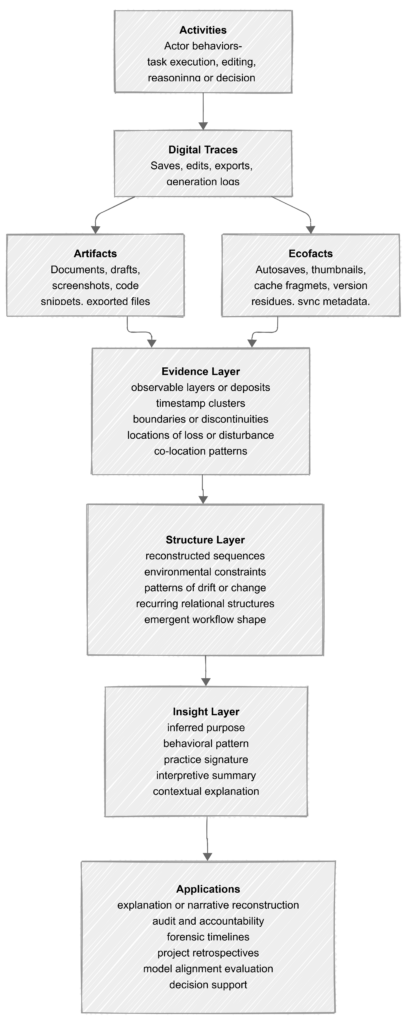
Activity → Trace → Environment → Time Model
This is the foundational logic of Information Archaeology.
It explains how digital material behaves and why it can be interpreted meaningfully.
Activity
Every digital artifact begins as a human action — writing, editing, exporting, renaming, “screenshotting”, collaborating.
Trace
Activities leave two categories of evidence:
- Artifacts — intentional digital objects: documents, drafts, code, exports
- Ecofacts — system-generated byproducts: autosaves, thumbnails, sync markers, metadata residues
Both are evidence. Both matter.
Environment
Systems shape traces just as strongly as humans do:
- file systems
- cloud sync behavior
- app migrations
- conversions
- versioning rules
- permissions
- backup strategies
Environment determines what survives, what changes, and what gets lost.
Time
Digital material accumulates in layers:
- versions
- drafts
- timestamp clusters
- migrations
- tool transitions
- metadata drift
- loss events
Time gives structure to the archive.
Artifacts, Ecofacts & Digital Material Culture
Digital information behaves like material culture:
Artifacts
Intentional objects created for communication or work.
Ecofacts
Unintentional byproducts created by systems, but shaped by human activity.
Ecofacts help reveal:
- environment boundaries
- workflow patterns
- editing intensity
- toolchains
- instability or loss
- drift and migration
Understanding both categories gives a complete picture of the digital past.
Digital Stratigraphy
Digital systems naturally produce layers, even when no one notices:
- directory depth
- version chains
- branching and forks
- timestamp deposits
- platform migrations
- duplicate clusters
- system residue
These strata reveal:
- sequences
- periods of heavy activity
- interruptions
- loss
- transitions
- instability
Stratigraphy is the “map” of digital work.
Context Reconstruction
Meaning lives in relationships.
Context comes from:
- provenance
- co-location
- relational metadata
- timestamps
- collaborators
- tool signatures
- surrounding artifacts and ecofacts
- shadow traces (screenshots, previews, cache)
Reconstructing context helps us understand not just what happened, but how and why.
Boundaries, Loss & Digital Taphonomy
Digital environments lose information constantly:
- overwritten versions
- corrupted files
- missing metadata
- cloud rewrites
- sync conflicts
- orphaned thumbnails
- mismatched timestamps
Loss isn’t a failure — it’s part of the system.
Frameworks in Information Archaeology treat loss as meaningful, not an obstacle.
Interpretation With Constraints
Interpretation in IA is:
- evidence-first
- provenance-bound
- multi-perspectival
- explicit about uncertainty
- grounded in what is observable
This ensures reconstructions are:
- defensible
- transparent
- repeatable
- ethical
- useful in legal, organizational, and analytical settings
Interpretation is not guesswork — it is disciplined reasoning within known boundaries.
The Three-Layer Structure of Analysis
IA organizes analysis into three layers:
A. Evidence Layer
Where raw traces live. This layer answers: “What is here?”
Includes analysis of:
- stratigraphy
- ecofacts
- loss
- metadata
- boundaries
- deposits
B. Structure Layer
Where evidence becomes organized meaning. This layer answers: “How did this happen?”
Includes:
- decision sequences
- environment modeling
- drift analysis
- provenance constraints
C. Insight Layer
Where interpretation takes shape. This layer answers: “What does this tell us about people, systems, and practice?”
Includes:
- composition analysis
- cultural inference
- meaning reconstruction
How the Frameworks Fit Together
These frameworks aren’t separate ideas — they are a single system.
Traces become layers.
Layers become sequences.
Sequences reveal environment.
Environment enables interpretation.
This unified structure lets practitioners analyze digital material with the same clarity and rigor used in physical evidence fields, but adapted to the unique behavior of digital systems.
Put the framework to work
The next step is understanding how IA’s layers translate into concrete techniques for reconstructing context, meaning, and workflow.
Explore the Methodology
Download the Whitepaper
Join us
Connect on LinkedIn to discuss digital information frameworks and methodologies.