A practical toolkit for interpreting digital traces as layered evidence.
Index
- Methodology Toolkit Diagram
- Introduction to the Methodology
- Evidence Layer Methods
- Structure Layer Methods
- Insight Layer Methods
- How Methods Work Together
- When to Use Each Layer
- Examples of Methodological Output
- Relationship to the Framework
Methodology Toolkit Diagram
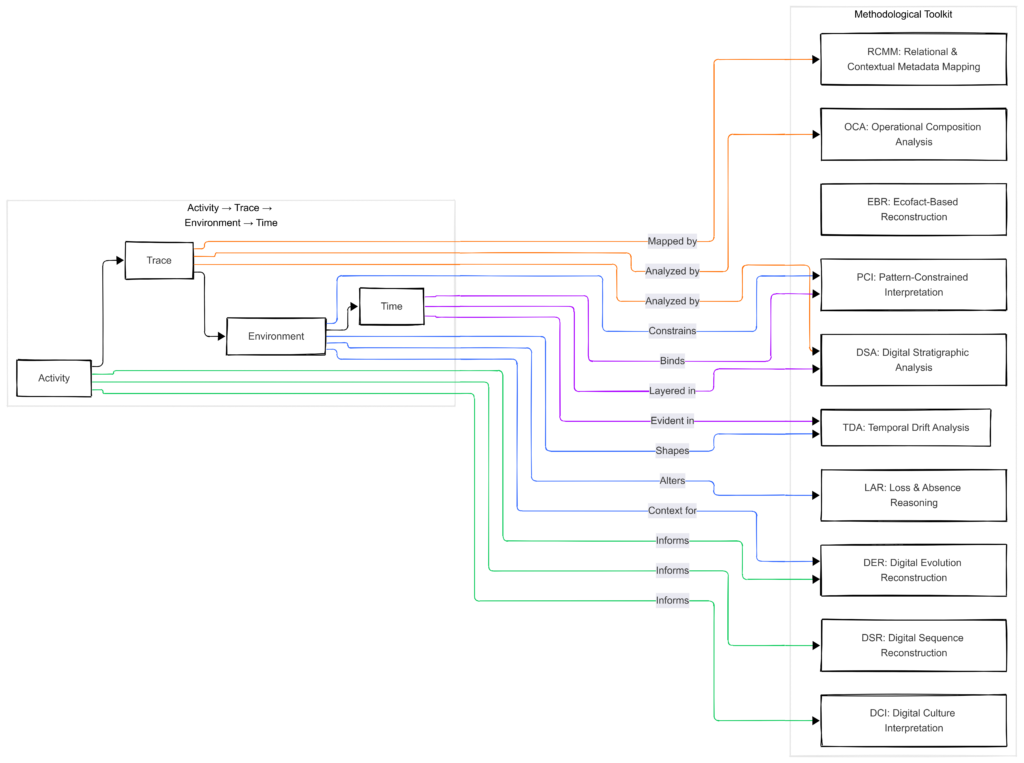
Introduction to the Methodology
Information Archaeology employs a structured, evidence-first methodology designed to interpret digital material in the same way an archaeologist interprets a site: by tracing layers, relationships, boundaries, disturbances, and residues left behind by both human and machine actors.
The methodology is organized across three analytical layers:
- Evidence Layer – What exists in the trace field
- Structure Layer – How the material relates, sequences, and organizes
- Insight Layer – What the structured evidence reveals
Each layer contains specific methods used to reconstruct context, meaning, workflow, and environmental influence. Together, these ten methods form a rigorous and defensible approach to interpreting digital history, behavior, and system interactions.
The Ten Methods (Layered Overview)
Evidence Layer Methods
These methods focus on what exists in the digital material itself — the strata, residues, patterns of loss, and relationships that form the raw evidence field.
1. Digital Stratigraphic Analysis (DSA)
Reads the layers, deposits, versions, and timestamp clusters that form the “strata” of digital work. Identifies periods of activity, discontinuities, migrations, and structural shifts.
2. Loss & Absence Reconstruction (LAR)
Identifies gaps, overwrites, deletions, and disturbances. Treats loss not as an obstacle but as meaningful evidence of system behavior, transitions, or activity intensity.
3. Relational & Contextual Metadata Mapping (RCMM)
Maps co-location, timestamps, naming patterns, folder structures, tool signatures, and relationships across artifacts and ecofacts. Builds the contextual field.
4. Ecofact-Based Reconstruction (EBR)
Analyzes system-generated traces (autosaves, caches, sync residues, thumbnails) to reveal environment boundaries, tool interactions, and events not visible in human-authored artifacts.
Structure Layer Methods
These methods use the evidence to reconstruct sequences, environments, patterns, and constraints.
5. Digital Sequence Reconstruction (DSR)
Rebuilds the order in which actions occurred: edits, exports, renames, saves, model runs, tool switches. Produces a defensible narrative of workflow sequences.
6. Digital Evolution Reconstruction (DER)
Identifies the systems, tools, constraints, pressures, permissions, and conditions that shaped the development of the digital material.
7. Temporal Drift Analysis (TDA)
Examines long-term shifts — naming conventions, structures, tool behavior, folder migrations, model changes, and environmental instability — to understand evolution over time.
8. Provenance-Constrained Interpretation (PCI)
Ensures interpretations remain grounded in the actual evidence. Makes uncertainty explicit, constrains inference, and keeps narratives defensible and transparent.
Insight Layer Methods
These methods produce meaning from the structured evidence, staying within the boundaries of provenance.
9. Operational Composition Analysis (OCA)
Analyzes the internal makeup of artifacts: content patterns, vocabularies, structures, residues, and thematic signatures. Reconstructs purpose and internal logic.
10. Digital Culture Interpretation (DCI)
Identifies patterns of practice or behavior visible in the traces — collaboration dynamics, workflows, model habits, timing patterns — always bounded by evidence.
How These Methods Work Together
The ten methods form a layered system:
- Evidence Layer reveals what exists and where
- Structure Layer reveals how it formed and why
- Insight Layer reveals what it means
This layered methodology ensures:
- clarity
- defensibility
- consistency
- responsible interpretation
- cross-domain usability (archives, AI, forensics, audits, research, transformation projects)
No single method is sufficient on its own.
The power of IA comes from how these layers constrain and inform one another.
When to Use Each Layer
Use the Evidence Layer when:
- Material is messy, large, or fragmented
- Gain understanding through deposits or residues
- Tools or systems have shaped the material
Use the Structure Layer when:
- Reconstructing workflow or activity sequences
- Identifying environmental influence
- Understanding drift, instability, or pattern emergence
Use the Insight Layer when:
- Explaining purpose or meaning
- Producing summaries or narratives
- Performing audits or reconstructions
- Building understanding for decision-makers
Examples of Methodological Output
- Reconstructed timeline
- Stratigraphic map
- Evidence field diagram
- Drift profile
- Provenance-constrained narrative
- Environment map
- Object composition matrix
- Interpretive summary
Relationship to the Framework
The methods correspond directly to the conceptual layers:
- Evidence Layer → What exists
- Structure Layer → How it formed
- Insight Layer → What it means
This mirrors the core IA conceptual flow:
Activity → Traces → Evidence → Structure → Insight → Application
Take the next step.
The ten methods form the backbone of Information Archaeology’s evidence-first approach.
To understand how these layers come together, explore the conceptual framework or read the full discipline whitepaper.
View the Frameworks
Download the Whitepaper
Join us
Connect on LinkedIn to discuss digital information frameworks and methodologies.